



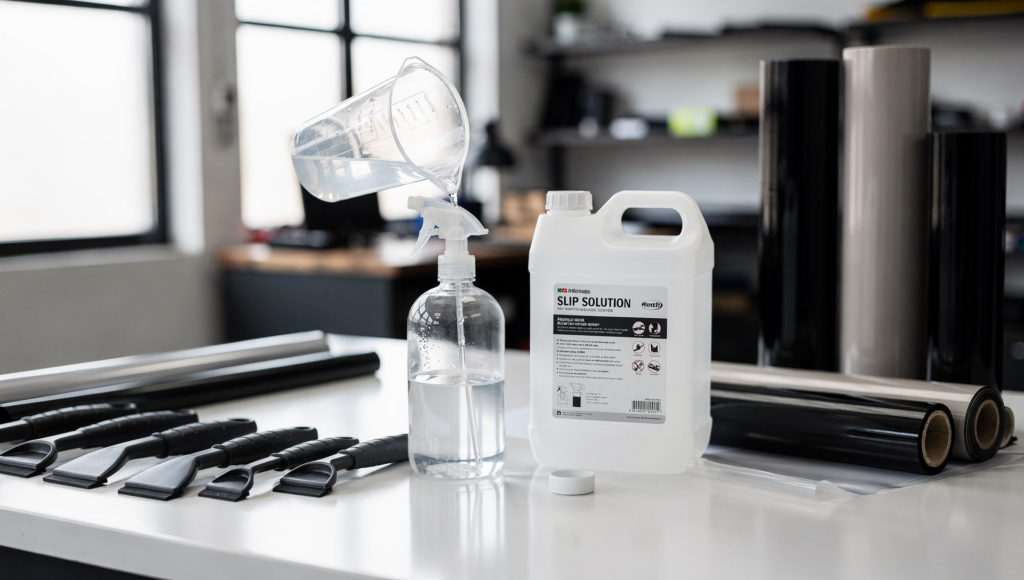
Ask ten installers how they mix slip solution and you will get ten answers — and a few will still say baby shampoo. This guide covers how to mix slip solution properly for window tint and PPF: the right ratios, why distilled water matters, how to adjust for heat, and what actually belongs in the bottle.
The quick version
- Slip solution has one job: let film slide into position without the adhesive grabbing early.
- Use distilled water — tap water minerals leave spots and can interfere with the adhesive.
- A purpose-built concentrate doses in millilitres per gallon, not squirts per bottle.
- On hot glass the answer is not more soap — it is slowing evaporation.
What slip solution actually does
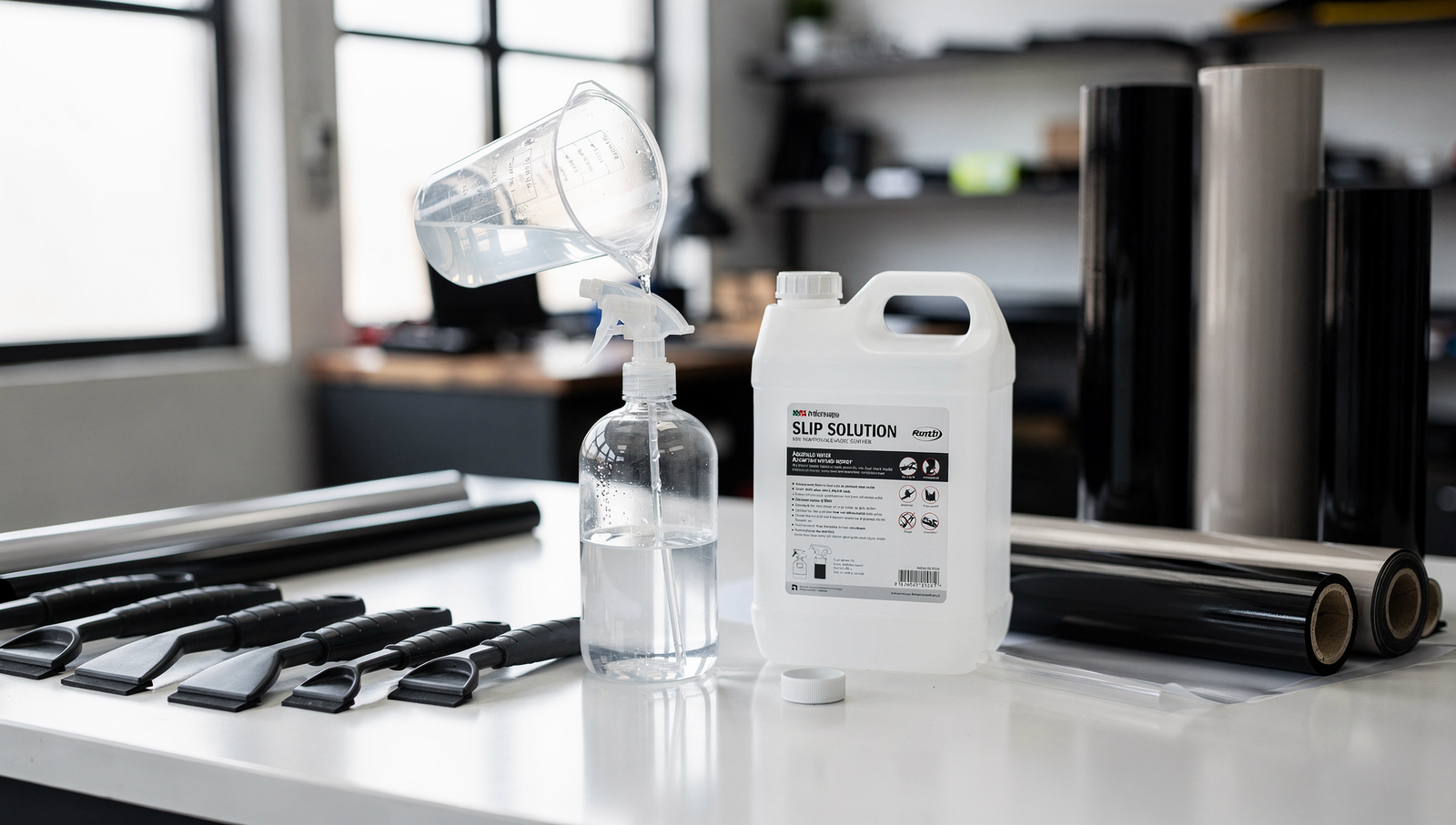
Slip solution reduces friction between the film adhesive and the glass or paint so the film can be slid into exact position, then squeegeed down. Too little slip and the film grabs before it is aligned; too much (or the wrong additive) and the adhesive cannot bond properly, leaving haze, lift lines or a install that never fully cures.
Why distilled water — not tap
Tap water carries dissolved minerals, chlorine and sometimes iron. Those minerals dry onto the glass and under the film, showing up as spotting, and they can interfere with adhesive bonding. Distilled water is the standard for a reason — it evaporates clean and leaves nothing behind. It is the cheapest quality upgrade in the whole process.
Mixing ratios that actually work
Ratios depend on the concentrate, the film and the conditions. As a starting point for a purpose-built slip concentrate:
| Application | Starting ratio | Notes |
|---|---|---|
| Window tint, normal conditions | 5–8 mL per gallon distilled | Adjust in 1 mL steps per gallon to taste |
| PPF, flat panels | Slightly richer than tint | More slip for repositioning large sheets |
| PPF, curves & body lines | Gel instead of thin slip | Gel holds position where liquid runs off |
| Hot glass / dry air | Same slip + evaporation control | Add 1 oz tack-control per gallon |
Mix in a clean, labelled bottle, shake gently (aggressive shaking foams it), and mix fresh — solution left sitting for weeks collects contamination.
The baby shampoo problem
Baby shampoo is the classic shop shortcut, and it does create slip. The trouble is what else is in it: oils, conditioners, fragrances and moisturisers. Those additives are designed to stay on skin, so they stay on your glass too — interfering with adhesive bonding and leaving residue that can cause haze and long-term adhesion issues. Formulations also change without notice, so the bottle you buy next month may behave differently.
We compared them directly in InstaSlip vs baby shampoo.
Slip, tack and gel — use the right one
Slip solution is not the only fluid on the bench, and the most common mixing mistake is trying to make one bottle do every job:
- Slip solution — thin, lets film slide freely. The default for flat glass and general tint work.
- Tack solution — slightly tacky, holds edges and dot matrix where slip would run off.
- Installation gel — viscous, clings to vertical and curved panels, and carries debris out during squeegeeing.
Full breakdown: slip, tack and gel explained and PPF gel vs slip solution.
Adjusting for heat
In summer, on dark glass, or in dry climates, the limiting factor is not slip — it is evaporation. Adding more concentrate does not help and can leave residue. Instead add an evaporation-control additive (roughly 1 oz per gallon) so the panel stays workable long enough to position and squeegee properly.
Common mixing mistakes
- Eyeballing the dose — inconsistent slip makes every install a gamble.
- Using tap water — mineral spotting and bonding problems.
- Household soaps — oils and conditioners you cannot flush out.
- One bottle for everything — use tack on dot matrix and gel on curves.
- Old solution — mix fresh and keep the bottle closed.
Shop the solutions
Purpose-built install chemistry, dosed by the millilitre and stocked for professionals:
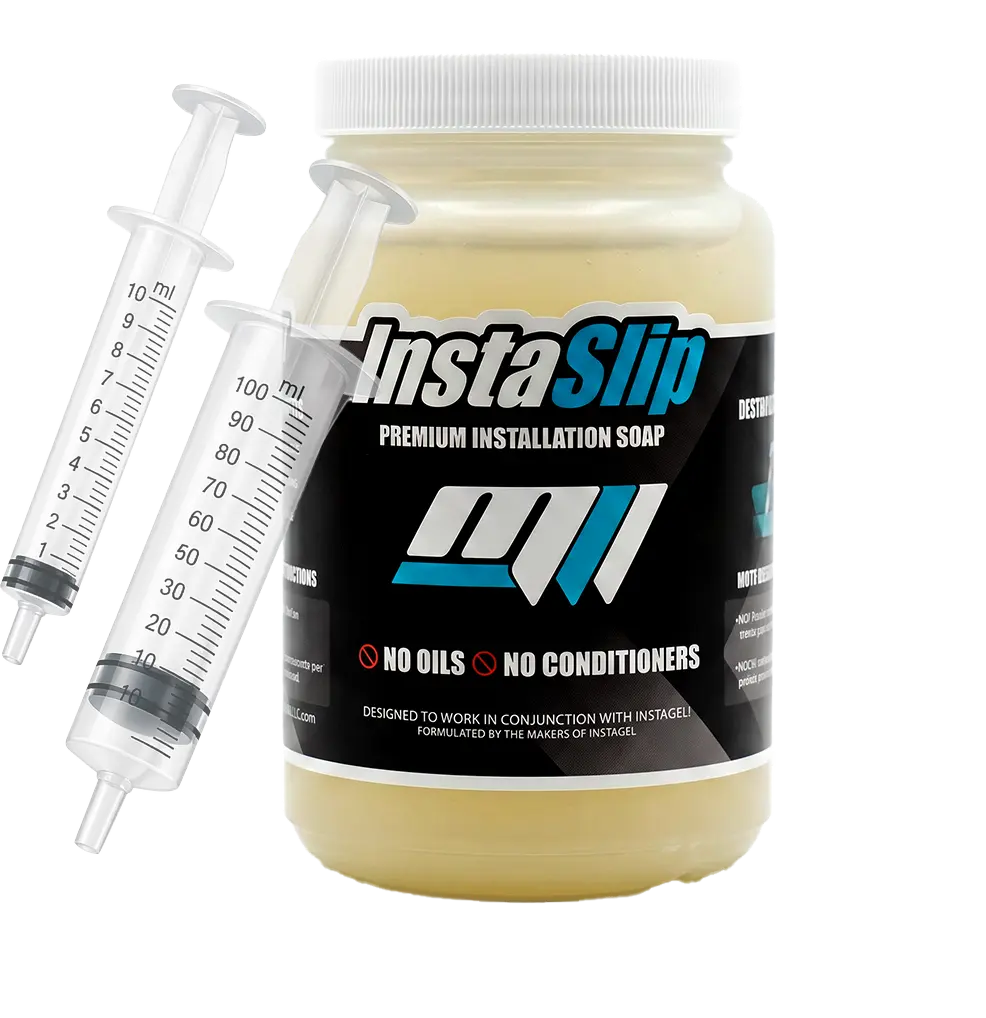 InstaSlipInstaSlip — oil-free, conditioner-free, flushes clean with distilled water.$23.99Shop →Tack Control
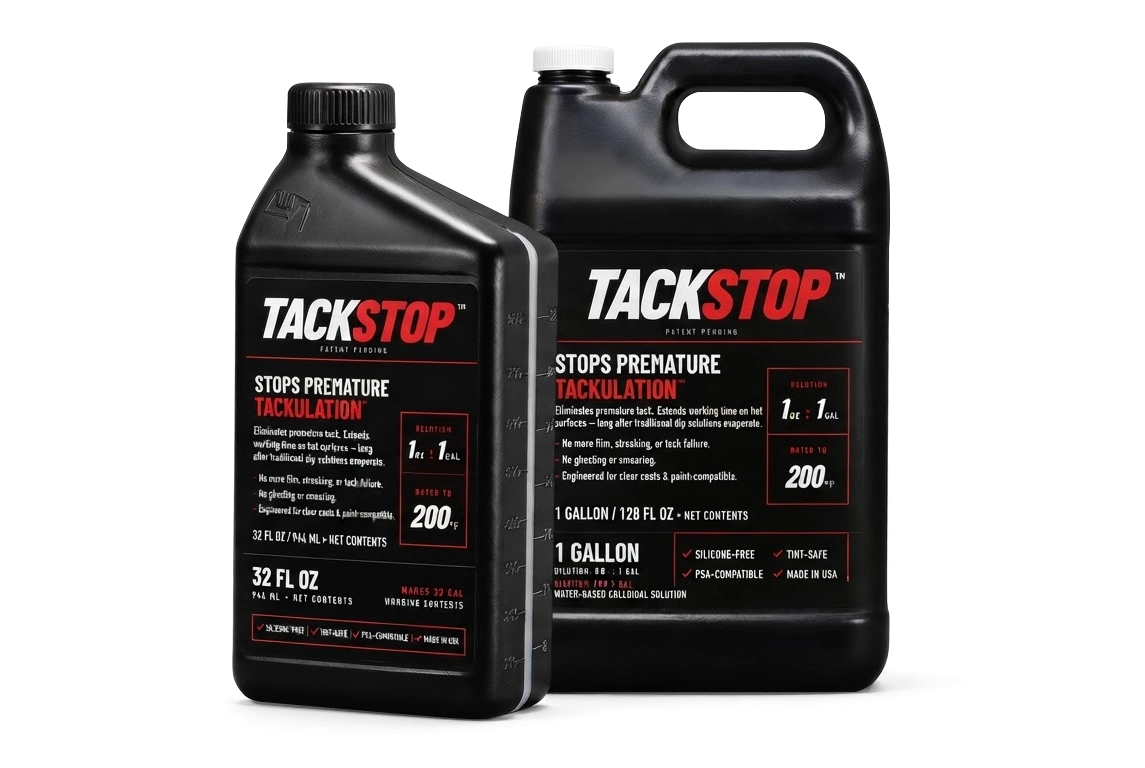 TackStop – Window Film Tack Control SolutionTackStop — 1 oz/gal for 3–5× more working time on hot glass.$27Shop →Install Gel
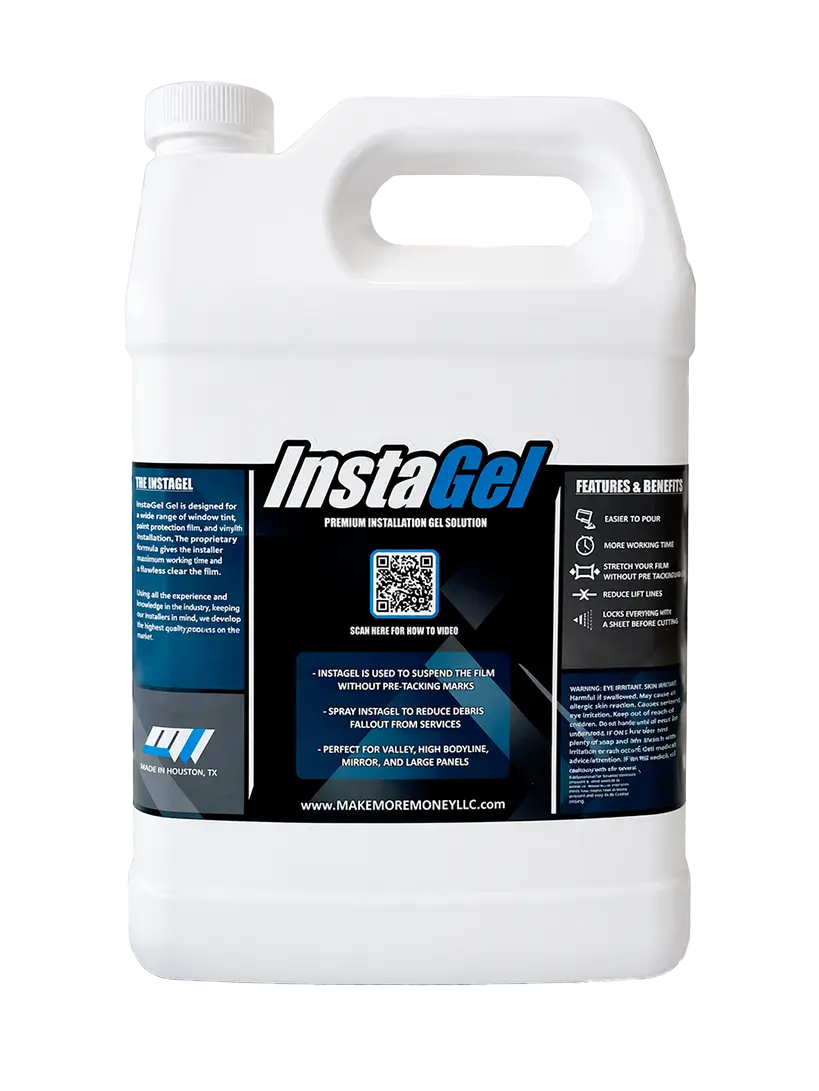 InstaGelInstaGel — controlled slip with tack for PPF curves and body lines.$32Shop →Tack Solution
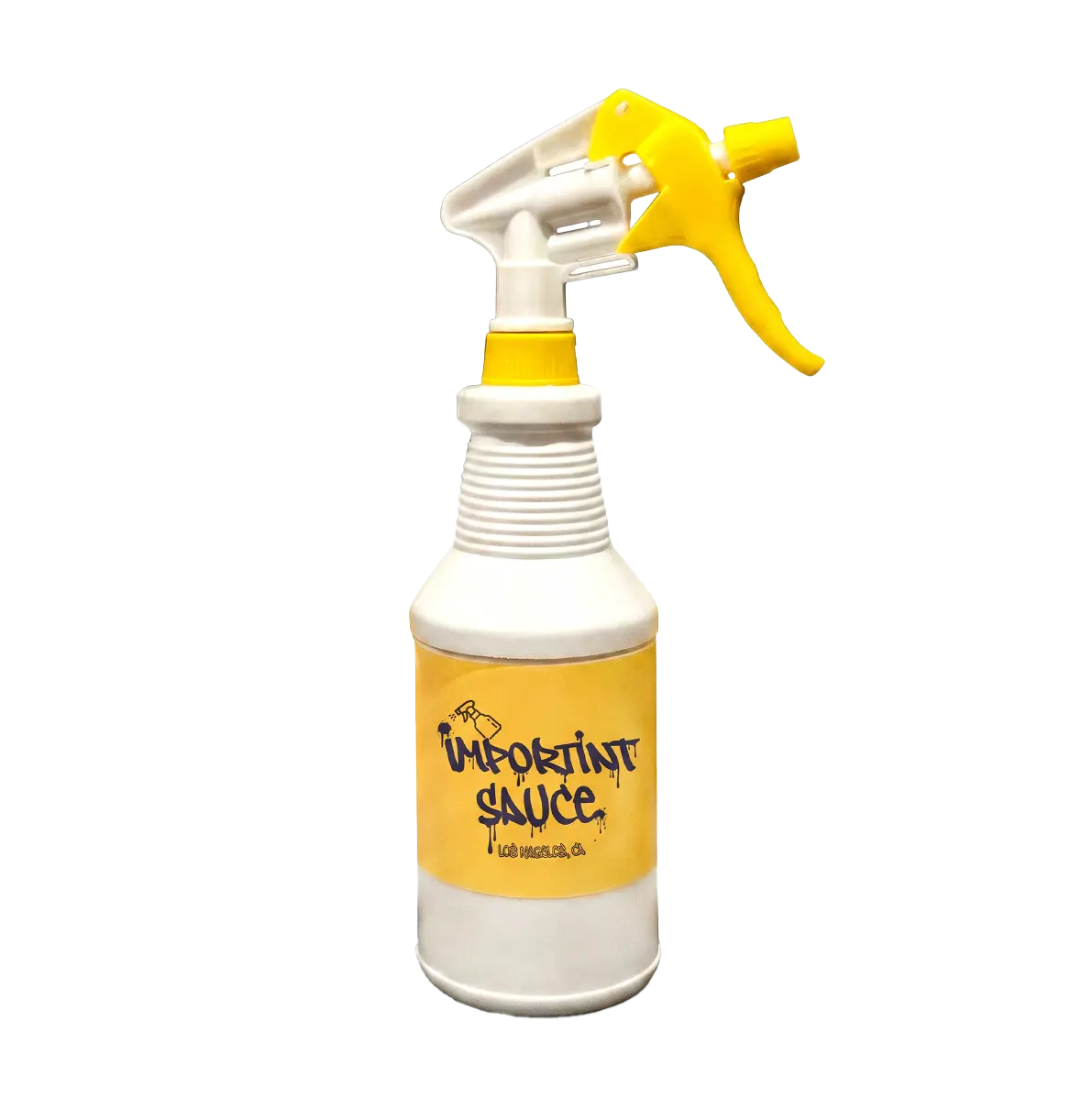 ImporTint SauceImporTint Sauce — locks edges and dot matrix on the first pass.$30Shop →
Slip solution FAQs
Start with roughly 5–8 mL of a purpose-built slip concentrate per gallon of distilled water, then adjust in 1 mL increments per gallon until the slip suits your film and conditions.
It works in the short term but contains oils, conditioners and fragrances that resist flushing, can interfere with adhesive bonding and may leave residue or haze. A purpose-built slip solution avoids all of that.
Yes for professional results. Tap water minerals dry onto the glass, cause spotting and can interfere with the adhesive bond.
Slip is thin and lets film slide freely; gel is viscous, clings to vertical and curved panels, and gives controlled slip with tack so film holds where you place it.
Add an evaporation-control additive (about 1 oz per gallon) rather than more slip concentrate, which slows evaporation and restores working time without leaving residue.
Mix it right, every time
Professional slip, tack and gel solutions at wholesale dealer pricing.
Shop Install Solutions